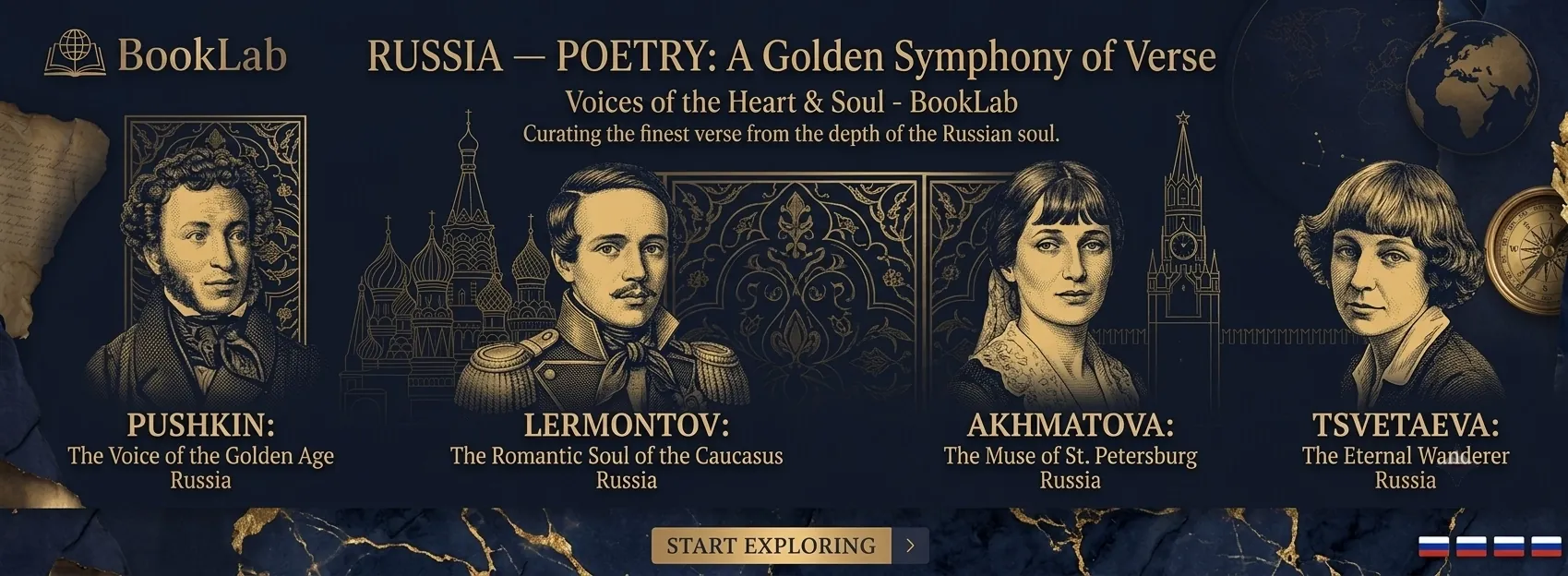
Alexander Pushkin
Александр Пушкин1799–1837
Father of modern Russian literature; his novel-in-verse Eugene Onegin defined the nation's literary language and Romantic spirit.
Signature worksEugene Onegin · The Bronze Horseman · Ruslan and Ludmila
📖 Read in BookLab →

Mikhail Lermontov
Михаил Лермонтов1814–1841
Poet of defiance and longing; his lyric verse and the restless Byronic hero gave Russian Romanticism its edge before his death in a duel at 26.
Signature worksA Hero of Our Time · The Demon · Death of the Poet
📖 Read in BookLab →


Anna Akhmatova
Анна Ахматова1889–1966
Voice of a silenced generation; Requiem bears witness to the suffering of the Stalinist terror with unbearable restraint.
Signature worksRequiem · Poem Without a Hero · Evening

Marina Tsvetaeva
Марина Цветаева1892–1941
Towering voice of the Silver Age, equal to Akhmatova in stature; her verse is intense, angular and fiercely alive.
Signature worksPoem of the End · Poem of the Mountain · After Russia
📖 Read in BookLab →

Gavrila Derzhavin
Гаврила Державин1743–1816
Grandee-poet of Catherine the Great's age whose majestic ode God and playful Felitsa bridged classicism and the Romantic dawn.
Signature worksFelitsa · God · The Waterfall

Vasily Zhukovsky
Василий Жуковский1783–1852
Father of Russian Romanticism and Pushkin's mentor, who taught Russian verse the music of the ballad and the German and English Romantics.
Signature worksSvetlana · Lyudmila

Fyodor Tyutchev
Фёдор Тютчев1803–1873
Metaphysical lyricist who set the human soul against a vast, living cosmos — ‘a thought once uttered is a lie.’
Signature worksSilentium! · Spring Storm

Afanasy Fet
Афанасий Фет1820–1892
Poet of pure sensation and ‘art for art's sake,’ whose famous lyric paints a whole love affair without a single verb.
Signature worksEvening Lights · Whisper, Timid Breathing

Nikolay Nekrasov
Николай Некрасов1821–1878
Conscience of the people's suffering, who turned peasant hardship into civic poetry and, as an editor, championed a whole generation of writers.
Signature worksWho Can Be Happy in Russia? · Red-Nosed Frost

Alexander Blok
Александр Блок1880–1921
Greatest of the Symbolists, whose revolutionary poem The Twelve marches twelve Red Guards through a blizzard behind a spectral Christ.
Signature worksThe Twelve · Verses About the Beautiful Lady

Sergei Yesenin
Сергей Есенин1895–1925
Golden-haired ‘last poet of the village,’ whose tender, self-lacerating lyrics of birch groves and lost Russia made him a national idol.
Signature worksMoscow Tavern · Confessions of a Hooligan

Nikolay Gumilyov
Николай Гумилёв1886–1921
Founder of Acmeism and poet-adventurer, executed at 35 — his crystalline verse prized craft, courage and the visible world.
Signature worksThe Pillar of Fire · The Quiver

Konstantin Batyushkov
Константин Батюшков1787–1855
Pushkin's ‘harmonious’ forerunner, whose sensuous, Italianate verse taught Russian poetry sweetness before madness silenced him.
Signature worksThe Dying Tasso · The Bacchante

Yakov Polonsky
Яков Полонский1819–1898
A lyric bridge between the Golden and Silver Ages, beloved for songlike verse of longing and the open road.
Signature worksThe Gypsy Girl · The Smugglers

Innokenty Annensky
Иннокентий Анненский1855–1909
Scholar-poet of muted anguish whose posthumous Cypress Casket secretly fathered Russian Acmeism.
Signature worksThe Cypress Casket · Quiet Songs

Andrei Bely
Андрей Белый1880–1934
Symbolist magician whose kaleidoscopic novel Petersburg Nabokov ranked among the century's greatest.
Signature worksPetersburg · Gold in Azure

Vladimir Mayakovsky
Владимир Маяковский1893–1930
Booming tribune of the Revolution who rebuilt verse in blocky, shouting steps before his suicide at 36.
Signature worksA Cloud in Trousers · The Bedbug

Mikhail Kuzmin
Михаил Кузмин1872–1936
Aesthete of ‘beautiful clarity,’ whose Alexandrian Songs brought a frank, sensual grace to Russian verse.
Signature worksAlexandrian Songs · The Trout Breaks the Ice

Osip Mandelstam
Осип Мандельштам1891–1938
Acmeist of stone and starlight who died in the Gulag for a poem against Stalin; his verse is Russia's marble conscience.
Signature worksTristia · The Stone

Boris Pasternak
Борис Пастернак1890–1960
Poet of dazzled wonder and author of Doctor Zhivago, forced to refuse the Nobel Prize his country could not forgive.
Signature worksDoctor Zhivago · My Sister, Life