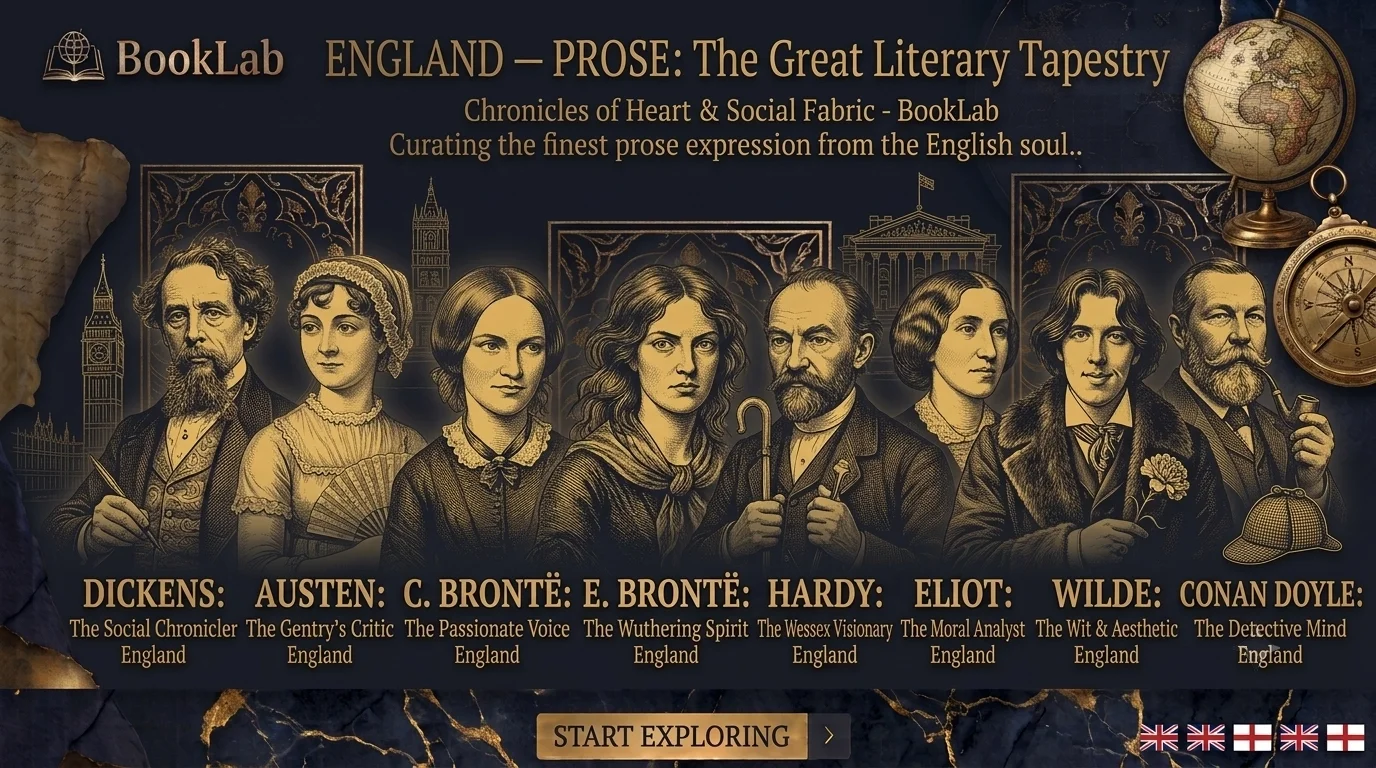
Charles Dickens
1812–1870
The great chronicler of Victorian England; his teeming novels married social conscience to unforgettable comedy and some of the most vivid characters in all fiction.
Signature worksGreat Expectations · A Tale of Two Cities · David Copperfield · Oliver Twist
📖 Read in BookLab →

Jane Austen
1775–1817
The supreme ironist of manners and marriage; her six novels turned the drawing room into a stage for the sharpest wit and moral intelligence in English.
Signature worksPride and Prejudice · Emma · Sense and Sensibility · Persuasion
📖 Read in BookLab →

Charlotte Brontë
1816–1855
Author of the first great novel of a woman’s inner life; Jane Eyre gave English fiction a heroine who insisted on her own conscience and worth.
Signature worksJane Eyre · Villette
📖 Read in BookLab →

Emily Brontë
1818–1848
Author of one wild, singular masterpiece; Wuthering Heights stands alone in its elemental passion and daring structure.
Signature worksWuthering Heights
📖 Read in BookLab →

Thomas Hardy
1840–1928
The tragic poet of rural Wessex; his novels set ordinary lives against an indifferent fate with unmatched pathos and grandeur.
Signature worksTess of the d’Urbervilles · Far from the Madding Crowd · Jude the Obscure
📖 Read in BookLab →

George Eliot
1819–1880
The most philosophical of Victorian novelists; Middlemarch is often called the greatest novel in English for its moral depth and psychological truth.
Signature worksMiddlemarch · Silas Marner · Adam Bede
📖 Read in BookLab →

Oscar Wilde
1854–1900
The wittiest voice of the age; his one novel and glittering comedies made the epigram an art form and aestheticism a creed.
Signature worksThe Picture of Dorian Gray · The Importance of Being Earnest
📖 Read in BookLab →

Arthur Conan Doyle
1859–1930
Creator of Sherlock Holmes and the modern detective story; his tales of reason and deduction remain the most beloved mysteries ever written.
Signature worksThe Adventures of Sherlock Holmes · The Hound of the Baskervilles · A Study in Scarlet
📖 Read in BookLab →

Robert Louis Stevenson
1850–1894
Master of the adventure and the moral fable; from pirate treasure to a divided soul, his tales are as thrilling as they are profound.
Signature worksTreasure Island · Dr. Jekyll and Mr. Hyde · Kidnapped
📖 Read in BookLab →

H. G. Wells
1866–1946
A father of science fiction; his scientific romances imagined time travel, alien invasion and human hubris a century before their time.
Signature worksThe War of the Worlds · The Time Machine · The Invisible Man
📖 Read in BookLab →

Rudyard Kipling
1865–1936
The great storyteller of empire and childhood; his fables and tales of India remain among the most vivid and enduring in English.
Signature worksThe Jungle Book · Just So Stories · Kim
📖 Read in BookLab →

Bram Stoker
1847–1912
Author of the definitive vampire novel; Dracula shaped a century of Gothic horror and remains a masterpiece of dread and suspense.
Signature worksDracula
📖 Read in BookLab →

Mary Shelley
1797–1851
Author of the first great work of science fiction; Frankenstein gave the modern world its enduring myth of creation and responsibility.
Signature worksFrankenstein; or, The Modern Prometheus
📖 Read in BookLab →

Lewis Carroll
1832–1898
The genius of literary nonsense; his Alice books turned logic and language into pure delight and remain beloved the world over.
Signature worksAlice's Adventures in Wonderland · Through the Looking-Glass
📖 Read in BookLab →

Daniel Defoe
1660–1731
A founder of the English novel; his realistic first-person narratives of survival and reinvention pioneered the form itself.
Signature worksRobinson Crusoe · Moll Flanders
📖 Read in BookLab →

Joseph Conrad
1857–1924
A master of the sea and the divided soul; writing in his third language, he brought a new moral depth and darkness to the English novel.
Signature worksHeart of Darkness · Lord Jim
📖 Read in BookLab →

Wilkie Collins
1824–1889
A founder of the detective and sensation novel; his intricate mysteries kept Victorian readers spellbound and shaped the genre for good.
Signature worksThe Moonstone · The Woman in White
📖 Read in BookLab →

Anthony Trollope
1815–1882
The genial chronicler of English cathedral towns and political life; his Barsetshire novels are among the warmest in the language.
Signature worksThe Warden · Barchester Towers
📖 Read in BookLab →

Walter Scott
1771–1832
The inventor of the historical novel; his sweeping romances of chivalry and the Scottish past enthralled all of Europe.
Signature worksIvanhoe · Rob Roy · Waverley
📖 Read in BookLab →

Elizabeth Gaskell
1810–1865
A humane observer of industrial England and provincial life; her novels balanced social conscience with tenderness and wit.
Signature worksNorth and South · Cranford
📖 Read in BookLab →

William Makepeace Thackeray
1811–1863
Dickens's great rival and the supreme satirist of Regency society; Vanity Fair holds up a merciless, glittering mirror to ambition.
Signature worksVanity Fair
📖 Read in BookLab →

James Joyce
Джеймс Джойс1882–1941
Exiled Dubliner who remade the novel — a single Dublin day in Ulysses became the modern epic of consciousness.
Signature worksUlysses · A Portrait of the Artist as a Young Man · Dubliners


George Orwell
Джордж Оруэлл1903–1950
Clear-eyed enemy of tyranny and cant, whose 1984 and Animal Farm gave the age its words for propaganda and control.
Signature works1984 · Animal Farm

John Bunyan
Джон Беньян1628–1688
Preacher and allegorist; The Pilgrim's Progress became one of the most read books in the English language.
Signature worksThe Pilgrim's Progress · Grace Abounding · The Holy War

Aldous Huxley
Олдос Хаксли1894–1963
Novelist and essayist whose dystopia Brave New World imagined an engineered future of pleasure and control.
Signature worksBrave New World · Point Counter Point · The Doors of Perception

D. H. Lawrence
Дэвид Герберт Лоуренс1885–1930
Novelist and poet who probed desire, class and the body with a candour that scandalised his age.
Signature worksSons and Lovers · Women in Love · Lady Chatterley's Lover

E. M. Forster
Эдвард Морган Форстер1879–1970
Novelist of liberal conscience; his motto “only connect” shaped stories of class, empire and human sympathy.
Signature worksA Passage to India · Howards End · A Room with a View

Graham Greene
Грэм Грин1904–1991
Master of the moral thriller; his “Greeneland” of faith, guilt and betrayal spanned the globe.
Signature worksThe Power and the Glory · The Heart of the Matter · The Quiet American

Iris Murdoch
Айрис Мёрдок1919–1999
Philosopher-novelist whose intricate fictions explored love, goodness and moral freedom.
Signature worksThe Sea, the Sea · Under the Net · The Bell

Agatha Christie
Агата Кристи1890–1976
The best-selling novelist of all time; her detectives Poirot and Marple defined the golden age of crime fiction.
Signature worksMurder on the Orient Express · The Murder of Roger Ackroyd · And Then There Were None

C. S. Lewis
Клайв Стейплз Льюис1898–1963
Scholar and Christian apologist whose Narnia and essays reached readers far beyond the academy.
Signature worksThe Chronicles of Narnia · The Screwtape Letters · Mere Christianity

J. R. R. Tolkien
Джон Рональд Руэл Толкин1892–1973
Philologist who invented Middle-earth; The Lord of the Rings founded modern epic fantasy.
Signature worksThe Lord of the Rings · The Hobbit · The Silmarillion